
How to do it
- Lie down or sit back, and breathe out fully through your mouth.
- Breathe in quietly through your nose for a count of four.
- Hold your breath for seven.
- Breathe out slowly through your mouth for eight — let it be heard, like a long sigh.
- That is one round. Do four, then breathe normally.
Four rounds take a little over a minute. It is often suggested to stay at four rounds at first and build up to eight over a few weeks. The counts are a ratio, not a rule: if seven feels long, count faster — and keep the out-breath about twice as long as the in-breath.
When it helps
4-7-8 breathing was made popular by the doctor Andrew Weil, who drew on the breathing practices of yoga (pranayama). Its long out-breath and slow pace make it a natural fit for the end of the day.
Use it in bed with the lights out, when you wake in the night and your thoughts start to run, or to come down after a long day. The hold is long, so it suits moments when you need to stay alert less well — then box breathing keeps you steadier.
What the research says
In a small study of 43 healthy young adults, three short sets of 4-7-8 breathing slowed their heart rate straight away; in those who had slept normally, heart rate variability shifted towards rest.
Vierra et al., Physiological Reports, 2022When 64 young adults spent 15 minutes each evening breathing slowly for 30 days, they rated their sleep better than a group who spent the time on social media — and their hearts showed more of the body’s resting activity through the night.
Laborde et al., Journal of Clinical Medicine, 2019Across 12 randomised trials with 785 adults, breathwork lowered stress compared with control groups.
Fincham et al., Scientific Reports, 2023
Few studies test 4-7-8 breathing on its own; the second is a study of slow breathing in general. These are studies of the exercises, not of Halebloom.
Take care
- The seven-count hold can make you light-headed at first. If it does, shorten the hold or breathe normally — never force it.
- Practise lying down or sitting, not while driving or in water.
- If you are pregnant, or have a heart or lung condition, ask your doctor before practising breath holds.
- Halebloom is a wellness app, not a medical device; breathing is not a treatment for insomnia or high blood pressure.
Questions
Does 4-7-8 breathing help you fall asleep?
Many people use it to wind down, and studies have linked slow breathing before bed with better sleep. It is not a sleeping pill: think of it as a way to quiet the body and give your attention one simple thing to follow.
How many rounds of 4-7-8 should I do?
Start with four rounds — a little over a minute. Over a few weeks you can build up to eight. More is not better: stop if you feel dizzy.
Why breathe out through the mouth?
A slow breath out through pursed lips, one you can hear, makes the long exhale easier to stretch and to feel. If it is more comfortable, breathe out through your nose — the length is what matters.
Does 4-7-8 breathing lower blood pressure?
It is not a treatment for blood pressure. Some small studies have measured short-term changes after slow breathing, but they are no substitute for care: if you have high blood pressure, follow your doctor’s advice.
4-7-8 or box breathing?
4-7-8 has a long hold and a longer out-breath — best for winding down and for sleep. Box breathing keeps four equal counts — steadier, better before something that needs focus. Both are free in Halebloom.
In Halebloom
4-7-8, without counting.
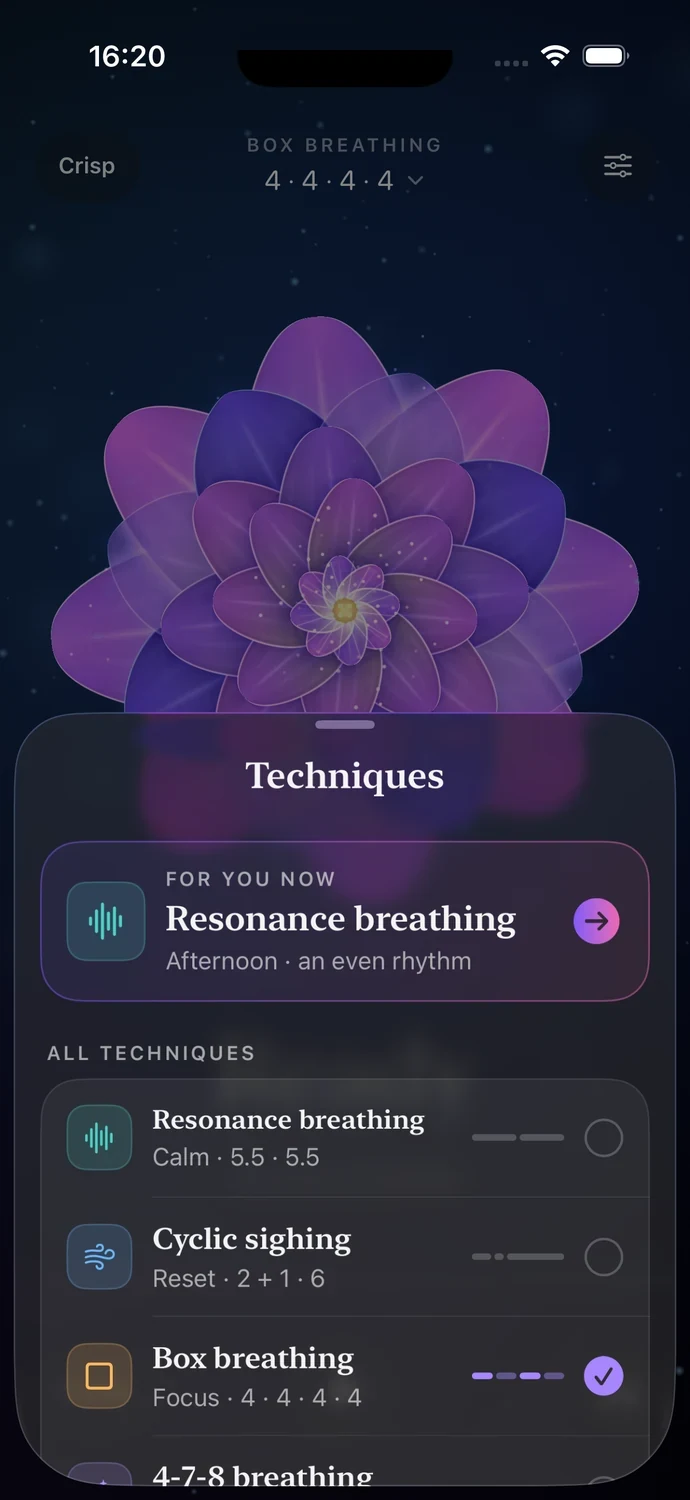
In Halebloom, 4-7-8 is one of six exercises, ready for the night. A living world opens as you breathe in, holds with you and closes slowly as you breathe out, so you never count in the dark; a voice (Pro) and soft taps on your wrist from Apple Watch carry you through with your eyes closed, and the screen stays awake for the whole session.

Free to download. Every exercise is free.
More exercises
- Resonance breathingCalm, even breathing · 5.5 · 5.5
- Cyclic sighingA quick reset · 2 + 1 · 6
- Box breathingSteady focus · 4 · 4 · 4 · 4
- Extended exhaleLetting the day go · 4 · 6
- Triangle breathingAn even rhythm · 4 · 4 · 4
All six breathing exercises · All six — and a living world to follow each — are in Halebloom. See the app