

How to do it
- Sit or lie comfortably and let your jaw and shoulders loosen.
- Breathe in through your nose for four.
- Breathe out slowly for six — through your nose, or through softly pursed lips.
- Let the next breath begin when the out-breath ends. No holds.
A few minutes is enough to feel the shift. Once four and six are easy, you can stretch the out-breath to eight — just keep it slow and unforced.
When it helps
When the out-breath is longer than the in-breath, breathing turns towards rest. That makes this the simplest of the six to start with: nothing to hold, nothing to count but the length of your out-breath.
Use it at the end of the day, after a tense conversation, when you lie down to sleep, or whenever you notice yourself breathing high and fast. It is the long out-breath of cyclic sighing and 4-7-8 breathing, on its own.
What the research says
In a study of 30 people, breathing out for longer than breathing in made them feel more relaxed and less stressed than the opposite — and at a slow pace it also raised the part of heart rate variability linked to rest.
Van Diest et al., Applied Psychophysiology and Biofeedback, 2014Under time pressure and noise, people breathing with a prolonged out-breath did better on a demanding task than with tactical (box) breathing.
Röttger et al., Applied Psychophysiology and Biofeedback, 2021In a month-long randomised study at Stanford, the most exhale-focused exercise — cyclic sighing — improved mood the most.
Balban et al., Cell Reports Medicine, 2023
These are studies of breathing with a long out-breath, not of Halebloom.
Take care
- The out-breath should be slow, not forced. If you feel dizzy or short of breath, breathe normally for a while.
- Don’t practise while driving or in water.
- If you have a heart or lung condition, ask your doctor before starting a breathing practice.
- Halebloom is a wellness app, not a medical device, and breathing exercises are not a treatment for anxiety disorders or insomnia.
Questions
Why does a longer out-breath help?
Your heart naturally slows a little each time you breathe out. A longer out-breath gives that slowing more time, and in studies people feel more relaxed breathing this way than with a longer in-breath.
How much longer should the out-breath be?
Start with four in and six out. When that is easy, try four in and eight out. Keep the in-breath comfortable and let the out-breath stretch on its own — no straining.
Nose or mouth?
Either. Breathing out through softly pursed lips, as if through a straw, makes a long out-breath easier to slow down; through the nose is quieter.
Is it good for sleep?
It is one of the gentlest ways to wind down: no holds, nothing to count. 4-7-8 breathing adds a long hold, if you want a stronger slowdown.
Extended exhale or cyclic sighing?
Both lean on a long out-breath. Cyclic sighing adds a double breath in and works fast in a stressful moment; the extended exhale is steadier, for a few calm minutes.
In Halebloom
Extended exhale, without counting.
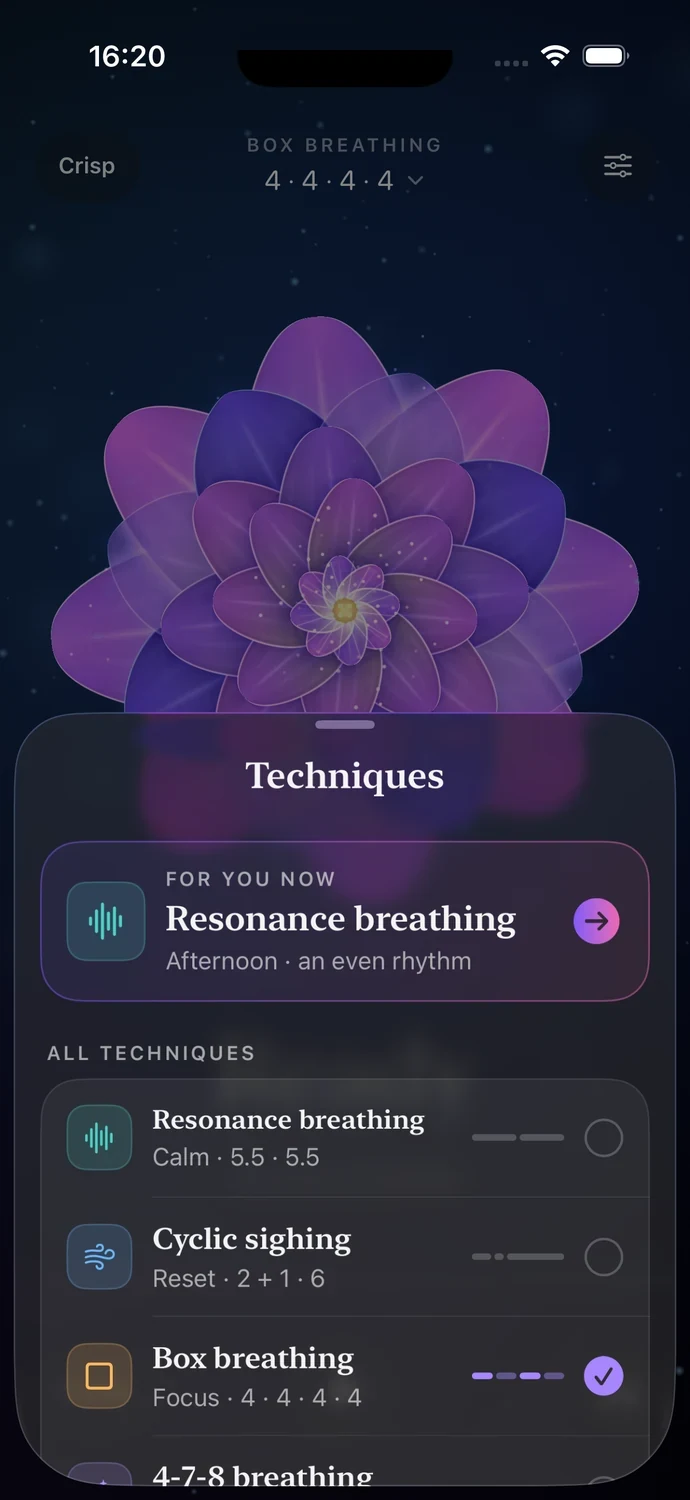
In Halebloom, the extended exhale is one of six exercises — the one for letting the day go. A living world opens as you breathe in and closes more slowly than it opened, so you never count; a voice (Pro) and soft taps from Apple Watch keep the rhythm with your eyes closed.

Free to download. Every exercise is free.
More exercises
- Resonance breathingCalm, even breathing · 5.5 · 5.5
- Cyclic sighingA quick reset · 2 + 1 · 6
- Box breathingSteady focus · 4 · 4 · 4 · 4
- 4-7-8 breathingTo wind down for sleep · 4 · 7 · 8
- Triangle breathingAn even rhythm · 4 · 4 · 4
All six breathing exercises · All six — and a living world to follow each — are in Halebloom. See the app