What is happening
Before something that matters, your body does what it has always done before a challenge: it speeds up your heart, makes your breathing quicker and higher, sends blood to your muscles and sharpens your attention. The shaking, the flush and the dry mouth all come from the same switch. It feels like a warning. It is really fuel.
Almost everyone feels it — fear of speaking in front of others is one of the most common fears there is. The aim is not to feel nothing. It is to keep the energy and lose the overdrive.
Ten minutes before
- Breathe out longer than you breathe in. In for four, out for six or eight. A long out-breath is the quickest way to tell your body it can ease off — and in one study, people under pressure who breathed out slowly did better at a demanding task. (The extended exhale, step by step.)
- Write down what worries you. Two or three lines, then put the paper away. Students who wrote about their worries just before an important exam scored higher — the anxious ones most of all.
- Say “I’m excited”, out loud. Not “calm down”. In studies of public speaking and singing, people who called their nerves excitement felt more excited and performed better than people who tried to calm down.
- Loosen what tightens. Drop your shoulders, unclench your jaw, shake out your hands, and say your first sentence out loud once, slowly.
One minute before: the sigh
If you only have a moment — in the corridor, at the side of the stage, while someone introduces you — use cyclic sighing: breathe in through your nose, sip in a little more, then let it all go in one long breath out through your mouth. One to three are enough. Nobody will notice: it looks like a sigh, because it is one.
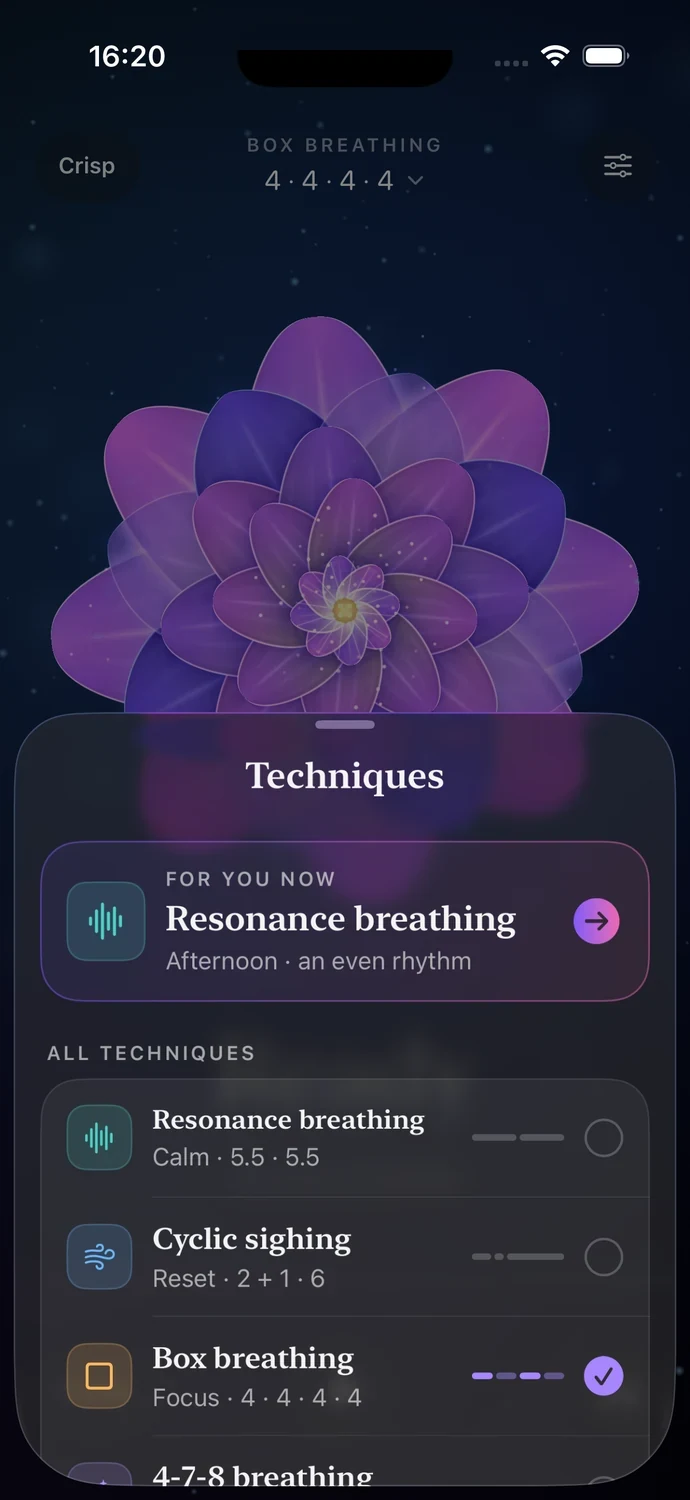
Breathe with the flower at the top of this page — it does exactly this. Or read the cyclic sighing guide.
While you speak
- Pause at the end of a point and breathe out before the next one. A pause feels endless to you; to the room it sounds sure.
- Speak on the out-breath, and let the in-breath come in the gaps — through your nose if you can.
- If your voice shakes, slow down and lower it a little: a longer out-breath steadies it.
After
When it is over, your body may stay revved for a while. A few minutes of slow breathing with a long out-breath brings it back down — and it is a good moment to notice what went well, not only what did not.
When it is more than nerves
For some people the fear of speaking is strong enough to make them avoid it, or it brings on panic. That is common, and it is treatable: therapies built on gradual practice help most people. If that sounds like you, talk to a doctor or a psychologist. Breathing exercises can help along the way, but they are not a treatment.
What the research says
People who reappraised their nerves as excitement — even just by saying “I am excited” out loud — felt more excited and did better at public speaking, singing and maths than people who tried to calm down.
Brooks, Journal of Experimental Psychology: General, 2014Under time pressure and noise, people breathing with a prolonged out-breath did better on a demanding task than with tactical breathing.
Röttger et al., Applied Psychophysiology and Biofeedback, 2021Writing about worries for a few minutes just before a high-stakes exam improved students’ scores, especially for those who usually get anxious about tests.
Ramirez and Beilock, Science, 2011In a month-long randomised study at Stanford, five minutes a day of breathing exercises improved mood more than mindfulness meditation — cyclic sighing most of all.
Balban et al., Cell Reports Medicine, 2023Fear of public speaking is very common, and it responds well to treatment, such as cognitive-behavioural programmes and practice in virtual reality.
Pull, Current Opinion in Psychiatry, 2012
Studies of these techniques, not of Halebloom.
Questions
How do I stop my voice from shaking?
Breathe out slowly before you start, then speak a little slower and lower than feels natural. A shaky voice usually steadies within the first minute, once you are speaking.
What is the fastest way to calm down before a presentation?
One to three slow sighs: two breaths in through the nose, one long breath out through the mouth. It takes under thirty seconds, and nobody notices.
Does box breathing help before a talk?
It can: four even counts give a racing mind something to hold on to. If you only have a minute, a long out-breath works faster. See box breathing.
Should I try to calm down completely?
No. Some arousal helps you speak with energy. Aim to take the edge off — then call what is left excitement.
Can I do this without anyone noticing?
Yes: breathe out slowly through your nose, or sigh once. With Halebloom on Apple Watch, soft taps on your wrist keep the rhythm while your eyes stay on the room.
In Halebloom
A minute before you go on.
Halebloom keeps the rhythm for you. Start a minute of cyclic sighing or an extended exhale from the Lock Screen, the Action Button or your watch: a living world opens and closes with each breath, and soft taps on your wrist from Apple Watch guide you without anyone seeing.

Free to download. Every exercise is free.