

How to do it
- Sit back with your feet on the floor and let your belly soften.
- Breathe in gently through your nose for about five and a half seconds, letting your belly rise first.
- Breathe out through your nose for the same five and a half seconds — no pause at the top or the bottom.
- Keep the breath smooth and quiet, like a wave coming in and going out.
Try ten to twenty minutes when you have them; five is still worth it. If five and a half seconds feels long, start at four and lengthen as it gets easy. Breathe gently — slower, not bigger.
When it helps
At around six breaths a minute, your heartbeat and your breath begin to rise and fall together: the heart speeds up a little as you breathe in and slows as you breathe out, in wide, even waves. That is why it is called resonance — and why it is the rhythm used in heart rate variability training.
It suits the times you want calm rather than a quick fix: in the evening, before sleep, in a long break, or as a daily practice. It is also called coherent breathing; the best pace differs a little from person to person, between about four and a half and seven breaths a minute.
What the research says
A review of 223 studies found that slow breathing raises heart rate variability — a sign of the body’s rest-and-recover system at work — during a session, straight after it, and after weeks of practice.
Laborde et al., Neuroscience & Biobehavioral Reviews, 2022In a lab study, people who breathed at their own resonance pace for 15 minutes reported a better mood afterwards than people who breathed one breath a minute faster, or simply sat quietly.
Steffen et al., Frontiers in Public Health, 2017A systematic review found slow breathing goes with more comfort and relaxation and less arousal and anxiety, alongside higher heart rate variability and more of the alpha brain waves of relaxed wakefulness.
Zaccaro et al., Frontiers in Human Neuroscience, 2018
These are studies of slow, resonance-paced breathing, not of Halebloom.
Take care
- Breathe gently. If you feel dizzy or short of breath, you may be breathing too deeply — make each breath smaller, or return to normal breathing.
- Don’t practise while driving or in water.
- If you have a heart or lung condition, ask your doctor before starting a breathing practice.
- Halebloom is a wellness app, not a medical device; slow breathing is not a treatment for any condition.
Questions
Why six breaths a minute?
For most adults, breathing at around six breaths a minute lines the heartbeat up with the breath, so heart rate variability rises the most. The exact pace differs a little for each person — between about four and a half and seven breaths a minute.
Is resonance breathing the same as coherent breathing?
Very nearly: both mean slow, even breathing at around five to six breaths a minute, with no holds. “Coherent breathing” usually names a fixed pace of five breaths a minute; resonance breathing aims for your own resonance pace.
How long should I practise?
Ten to twenty minutes is typical in studies, often once or twice a day. Even five minutes helps you settle; a little every day counts for more than a lot once.
Should I breathe through my nose?
Through the nose is the easiest way to keep it slow and quiet, but the pace is what matters. If your nose is blocked, breathe gently through your mouth.
Resonance breathing or box breathing?
Resonance breathing has no holds — slow, even waves, good for calm and for heart rate variability. Box breathing adds holds and four equal counts — steadier and more alert, good before something that needs focus.
In Halebloom
Resonance breathing, without counting.
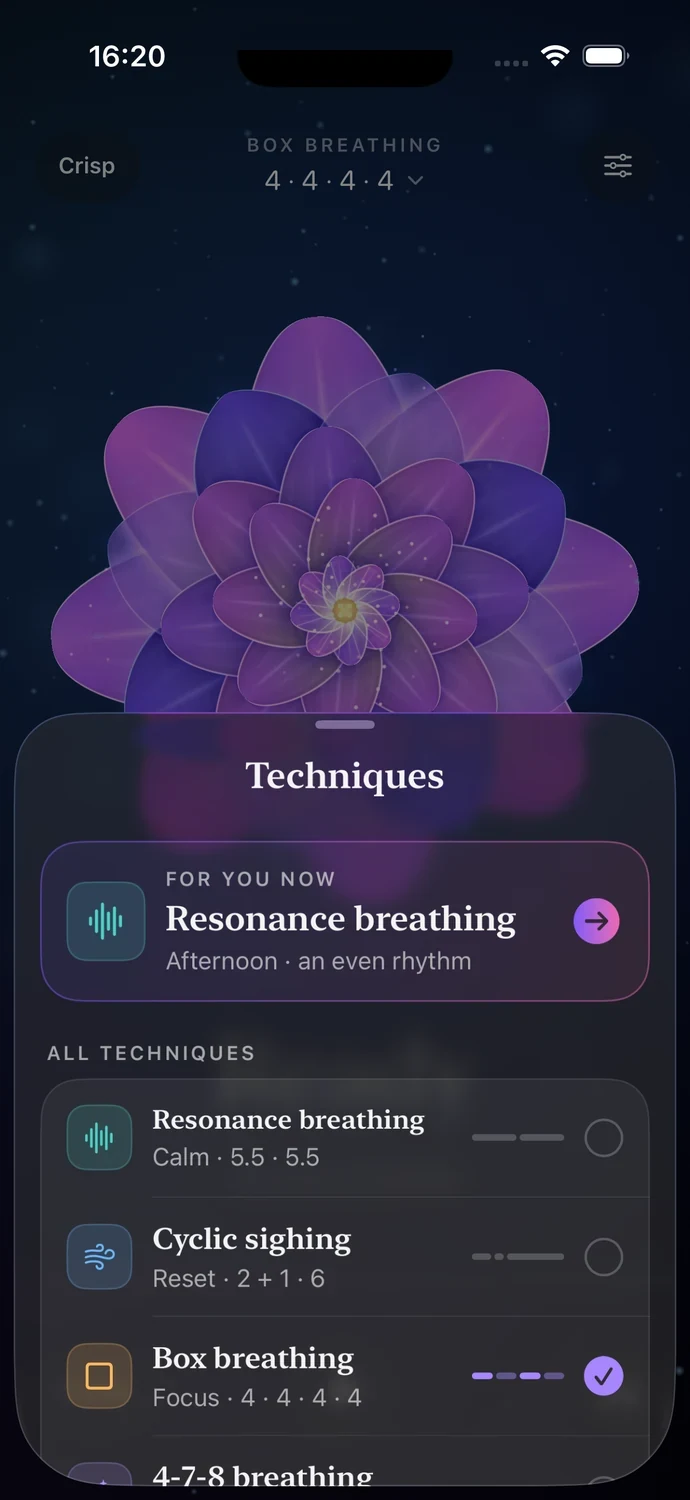
In Halebloom, resonance breathing is one of six exercises. A living world opens slowly as you breathe in and closes as you breathe out, five and a half seconds each way, so you never count; a voice (Pro) and soft taps from Apple Watch keep you on pace with your eyes closed, and you can measure your pulse before and after.

Free to download. Every exercise is free.
More exercises
- Cyclic sighingA quick reset · 2 + 1 · 6
- Box breathingSteady focus · 4 · 4 · 4 · 4
- 4-7-8 breathingTo wind down for sleep · 4 · 7 · 8
- Extended exhaleLetting the day go · 4 · 6
- Triangle breathingAn even rhythm · 4 · 4 · 4
All six breathing exercises · All six — and a living world to follow each — are in Halebloom. See the app