

How to do it
- Sit or stand comfortably and let your shoulders drop. Breathe out gently, all the way.
- Breathe in through your nose for a slow count of four.
- Hold with your lungs full for four. Stay soft — no straining.
- Breathe out through your nose or mouth for four.
- Hold with your lungs empty for four, then begin again.
Four rounds take about a minute. Keep going for three to five minutes, or for as long as it feels easy. If four seconds is too long, start at three — the square matters more than its size.
When it helps
Box breathing gives a busy mind something simple to hold on to: four even counts, over and over. Every side is the same, so it is easy to remember and easy to keep — even with your eyes open, in a room full of people.
It suits the moments before something that needs a clear head — a talk, an exam, a difficult call — and the moments after something has rattled you. That is why it is taught as “tactical breathing” to soldiers and police.
If what you want is to wind down for sleep, a longer out-breath helps more: try 4-7-8 breathing.
What the research says
In a month-long randomised study at Stanford, people spent five minutes a day on box breathing, cyclic sighing, another breathing exercise or mindfulness meditation. The breathing exercises lifted mood more than meditation did — cyclic sighing, with its long out-breaths, most of all.
Balban et al., Cell Reports Medicine, 2023In a lab study of 30 people working under time pressure and noise, tactical breathing — box breathing as soldiers and police learn it — left the body calmer than slow out-breaths did, though the slow out-breaths helped them perform better.
Röttger et al., Applied Psychophysiology and Biofeedback, 2021Across 12 randomised trials with 785 adults, breathwork lowered stress compared with control groups.
Fincham et al., Scientific Reports, 2023
Box breathing on its own has been studied less than slow breathing in general. These are studies of the exercise and of breathwork, not of Halebloom.
Take care
- The holds should feel easy. If you feel dizzy or short of breath, let them go and breathe normally.
- Don’t practise while driving or in water.
- If you are pregnant, or have a heart or lung condition, ask your doctor before practising breath holds.
- Halebloom is a wellness app, not a medical device, and breathing exercises are not a treatment for anxiety disorders.
Questions
How long should I do box breathing?
A minute — about four rounds — is enough to notice it. Three to five minutes makes a comfortable session. There is no prize for going longer: stop when it stops feeling easy.
Is box breathing good for anxiety?
It can help you settle in an anxious moment: slow, even counts give your attention something to follow, and studies of breathwork find it lowers stress. It is not a treatment for an anxiety disorder — if anxiety runs your days, talk to a doctor.
What is the difference between box breathing and cyclic sighing?
Box breathing keeps four equal counts with holds — steady, good for focus. Cyclic sighing is a double breath in through the nose and a long breath out through the mouth, with no holds; in the Stanford study it lifted mood the most. Halebloom has both.
What if four seconds is too long?
Shorten every side to three, or even two — just keep them equal. In Halebloom you can set your own counts, or let it start at your own pace and slow down with you.
Can I do box breathing with my eyes closed?
Yes — the hard part is counting in your head. Halebloom keeps the count for you: watch the world open and close, listen to the voice guide, or feel soft taps from Apple Watch at every turn of the breath.
In Halebloom
Box breathing, without counting.
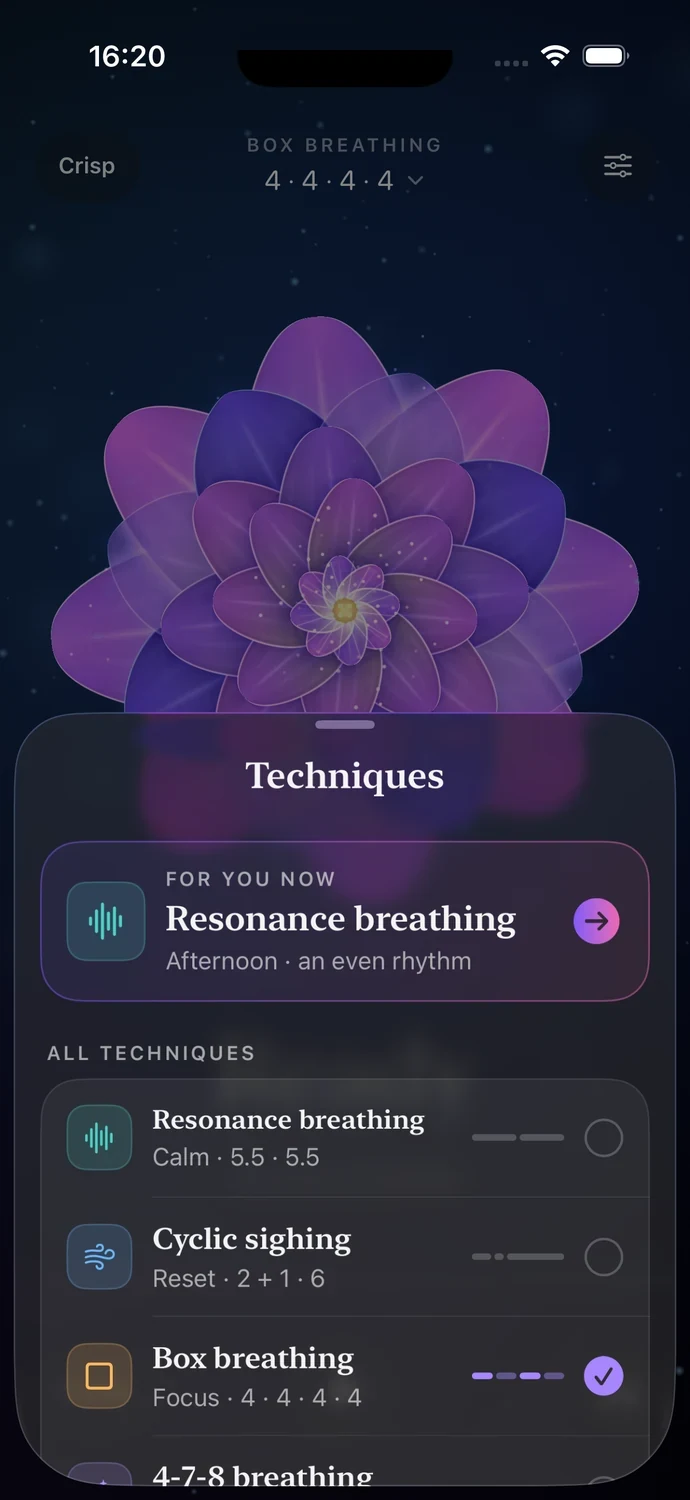
In Halebloom, box breathing is one of six exercises. A living world opens as you breathe in and closes as you breathe out, so you never count; a voice (Pro) and soft taps on your wrist from Apple Watch keep the rhythm when your eyes are closed. Start at your own pace, set your own counts, or let it slow down with you.

Free to download. Every exercise is free.
More exercises
- Resonance breathingCalm, even breathing · 5.5 · 5.5
- Cyclic sighingA quick reset · 2 + 1 · 6
- 4-7-8 breathingTo wind down for sleep · 4 · 7 · 8
- Extended exhaleLetting the day go · 4 · 6
- Triangle breathingAn even rhythm · 4 · 4 · 4
All six breathing exercises · All six — and a living world to follow each — are in Halebloom. See the app