Why thoughts get louder at night
In the day, your attention has plenty to hold on to. In bed, in the dark, nothing is left to drown out the unfinished things: the email still unsent, tomorrow’s meeting, something someone said. Your mind treats them as problems to solve — and solving keeps you awake.
Then a second worry joins the first: “I need to sleep.” Every look at the clock, every sum of the hours left, pushes sleep a little further away. That is why trying harder to sleep rarely works. What helps is moving the thoughts somewhere else, and letting your body slow down on its own.
Before bed
- Give your worries a slot — earlier in the evening. Take ten minutes after dinner. For each thing on your mind, write the next small step, or “nothing to do tonight”. Students with insomnia who wrote down solutions to their worries for a few evenings went to bed with calmer minds than those who only wrote the worries down.
- Write tomorrow’s to-do list, in detail. Five minutes, just before bed. In a sleep-lab study, people who wrote a to-do list fell asleep faster than people who wrote about what they had already done — and the more specific the list, the faster they fell asleep. The list holds the tasks, so your head doesn’t have to.
- Breathe slowly for a while. Six breaths a minute — in for four, out for six — for ten to twenty minutes before you sleep. In a small study of people with insomnia, twenty minutes of slow, paced breathing before bed helped them fall asleep sooner and wake less in the night.
In bed, when the thoughts start
- Breathe out longer than you breathe in. In through your nose for four, out for six — slowly, without forcing it. Counting gives your mind one small job; the long out-breath tells your body it can let go. (The extended exhale, step by step.)
- Picture something, in detail. Not “stop thinking” — that rarely works. Pick a place you love or a walk you know well, and fill it in: the light, the sounds, the path under your feet. In one study, people with insomnia who held a vivid picture like this fell asleep sooner than those given no instructions.
- Leave the clock alone. Turn it to the wall. Knowing it is 3:12 only starts the sum of hours left.
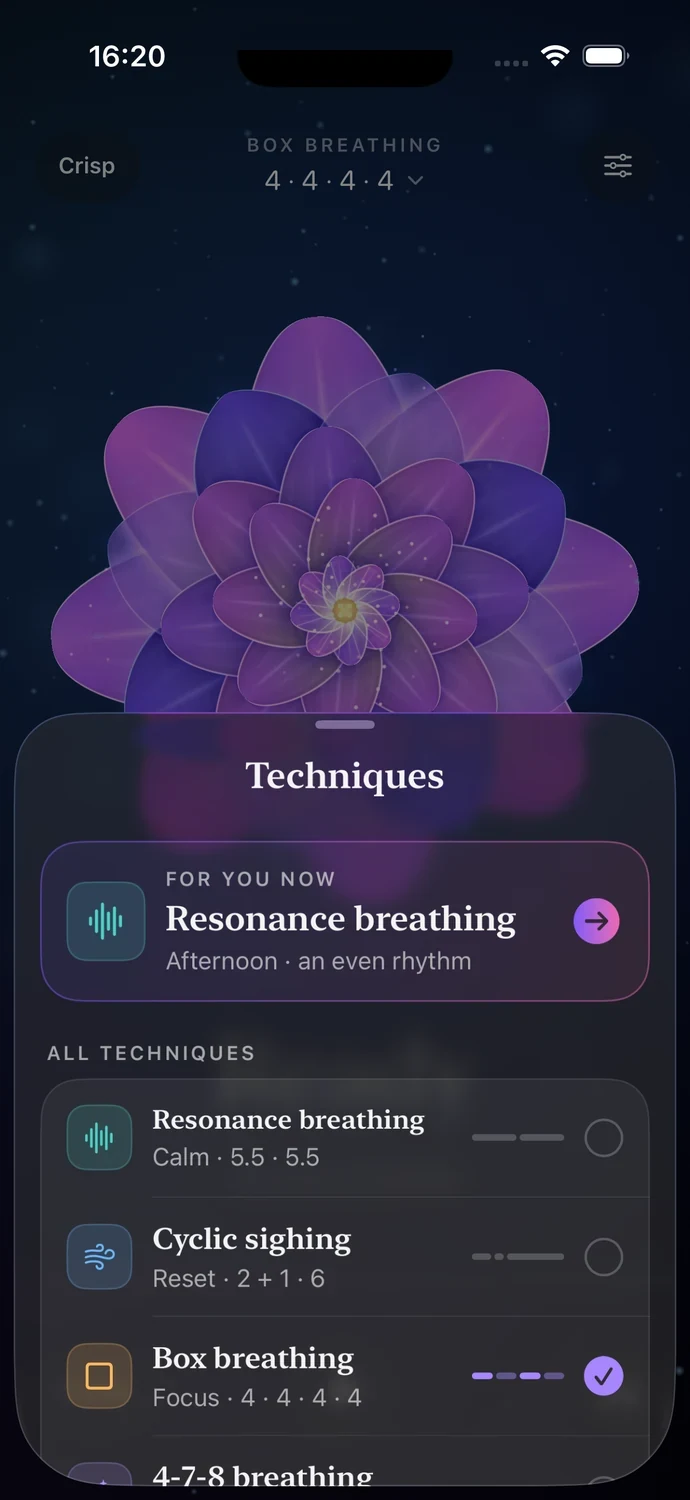
Breathe with the world at the top of this page: in for four, out for six. Or try 4-7-8 breathing, with its long hold, if that suits you better.
If sleep still won’t come
If you have been lying awake for a while — around twenty minutes, by feel, not by the clock — get up. Go somewhere with dim light and do something quiet and dull until you feel sleepy, then go back to bed. It sounds backwards, but it teaches your body that bed is for sleeping, not for lying awake and thinking. Sleep doctors call it stimulus control.
When it is more than a bad night
If you struggle to fall asleep or stay asleep three or more nights a week, month after month, or tiredness gets in the way of your days, talk to a doctor. Long-lasting insomnia is common, and it is treatable: the first treatment sleep doctors recommend is cognitive behavioural therapy for insomnia (CBT-I), a short course of sessions — some of them online. Breathing exercises can help along the way, but they are not a treatment.
What the research says
People who spent five minutes before bed writing a specific to-do list fell asleep faster in a sleep lab than people who wrote about what they had already done; the more specific the list, the faster they fell asleep.
Scullin et al., Journal of Experimental Psychology: General, 2018Students with insomnia who wrote down possible solutions to their worries in the evening had less mental arousal before sleep than those who only recorded their worries.
Carney and Waters, Behavioral Sleep Medicine, 2006In a small sleep-lab study, people with insomnia who practised slow, paced breathing — six breaths a minute — for twenty minutes before bed fell asleep sooner, woke less often and slept more efficiently.
Tsai et al., Psychophysiology, 2015People with insomnia who kept their minds on an engaging imagined scene fell asleep sooner, with fewer unwanted thoughts, than those given no instructions.
Harvey and Payne, Behaviour Research and Therapy, 2002For long-lasting insomnia, sleep doctors recommend cognitive behavioural therapy first; stimulus control and relaxation are among the single techniques they suggest, and sleep hygiene on its own is not enough.
Edinger et al., Journal of Clinical Sleep Medicine, 2021
Studies of these techniques, not of Halebloom.
Questions
Which breathing is best for falling asleep?
Any slow breathing with a longer out-breath: in for four, out for six is a good start. 4-7-8 adds a long hold, which some people find calming and others find too much. Pick the one you can keep up without effort — see the extended exhale and 4-7-8.
How long should I breathe before sleep?
A few minutes already helps you settle; in the study above, people breathed slowly for twenty. Ten to twenty minutes, in bed or just before, is a good range.
Should I get up if I can’t sleep?
Yes, if you have been awake for a while and feel restless. Get up, keep the light low, do something quiet, and go back when you feel sleepy.
What if I wake at 3 a.m. and the thoughts start?
The same steps: don’t check the time, breathe out slowly, picture something in detail. If one thing keeps nagging, write it down in a line and leave it for the morning.
Can I do this with my eyes closed?
Yes. Start a session in Halebloom, put the phone face down and follow the voice (Pro) or soft taps on your wrist from Apple Watch — there is nothing to watch and nothing to count.
In Halebloom
A slower breath, with your eyes closed.
Halebloom keeps the rhythm for you. Start an extended exhale or 4-7-8 from the Lock Screen or Apple Watch, close your eyes, and follow the voice (Pro) or soft taps on your wrist, with no screen to watch. Every session is saved to Apple Health as Mindful Minutes.

Free to download. Every exercise is free.